
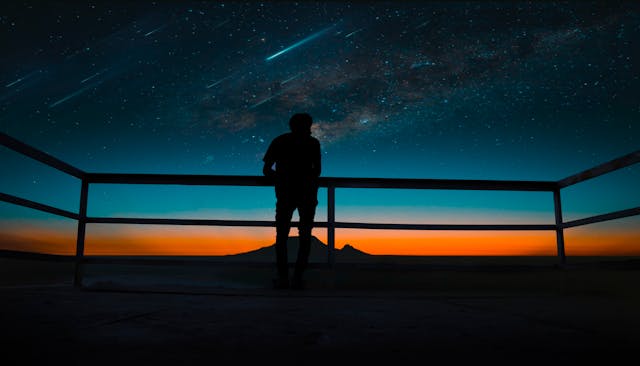
There’s something about autumn that feels like the sky is leaning in a little closer. The evenings arrive earlier, the air sharpens, and suddenly we’re gifted more hours under the stars. It’s as if the cosmos knows we’re ready to swap summer’s sun-soaked distractions for quiet, fire-breathing constellations.
Autumn is a season of transitions — leaves curl into russet spirals, animals gather for winter, and the heavens above begin their own slow shift. The great square of Pegasus strides into the night, Cassiopeia lounges on her celestial throne, and the Seven Sisters — the Pleiades — shimmer like frost on black velvet. They return each year, familiar but never ordinary, a reminder that we’re part of a rhythm older than every oak in the forest.
And then there are the planets, shining like stubborn jewels that refuse to be outdone. Jupiter often blazes brighter than any star, its Galilean moons waiting for anyone with binoculars to discover. Saturn lingers too, its rings tilted just so — delicate loops of ice and rock visible through even a modest telescope. Autumn nights may carry a chill, but the sky offers warmth in wonder.
Meteor showers are the season’s confetti. The Orionids streak from the hunter’s shoulder in late October, leaving fleeting silver scars across the night. A few weeks later, November’s Leonid’s arrive, famous for storming the heavens with thousands of meteors per hour in rare outbursts. Most years, they’re gentler — but even a handful of shooting stars is enough to spark awe, especially if you’re wrapped in a blanket with hot cocoa in hand.
And of course, autumn’s moons are spectacles in themselves. Each full moon rises with a name carried from folklore and farming traditions, marking the pace of the season:
- September – The Harvest Moon, glowing bright to light the fields long after sunset.
- October – The Hunter’s Moon, bold and coppery, guiding the season of preparation.
- November – The Beaver Moon, named for the time when beavers prepared for winter in their lodges.
These moons are not just markers of time — they are invitations. Their glow is perfect for setting intentions, meditating, or simply admiring the silver wash across the world. And for those who keep crystals, each full moon offers the perfect chance to let them rest in lunar light. Place them on a windowsill or outside where the beams can reach them, and let the moon recharge them — whether you believe in the energy or simply love the ritual.
🌕 Autumn–Winter 2025 Full Moons
- Harvest Moon (September 7)
UK: 19:09 BST | US: 14:09 EDT
✨ Bright fields, balance, beginnings. - Hunter’s Moon (October 6–7)
UK: 04:48 BST (7th) | US: 23:48 EDT (6th)
✨ Courage, clarity, gathering energy. - Beaver Moon (November 5)
UK: 13:19 GMT | US: 08:19 EST
✨ Protection, preparation, stillness. - Cold Moon (December 4)
UK: 23:14 GMT | US: 18:14 EST
✨ Release, reflection, crystal recharge.
The beauty of autumn astronomy is not just in what you see but in how it makes you feel. To step outside on a crisp night, breath misting, stars unfolding overhead — it’s a kind of magic that requires no ticket, no password, no app. Just time, patience, and maybe a pair of mittens.
So this season, let the dark be your invitation. Wander into it, look up, and welcome autumn not just with pumpkins and scarves, but with galaxies, moons, and meteors. And when the full moon rises, don’t forget your crystals — the universe is waiting, and it’s wearing its best autumn cloak.
Love Life & Discover Yourself x
References & Further Exploration
- Royal Astronomical Society: https://ras.ac.uk
- NASA – What’s Up Skywatching Tips: https://solarsystem.nasa.gov/whats-up
- International Meteor Organization – Meteor Shower Calendar: https://www.imo.net
- Sky & Telescope – Autumn Sky Guide: https://skyandtelescope.org
- The Old Farmer’s Almanac – Moon Names: https://www.almanac.com/full-moon-dates