
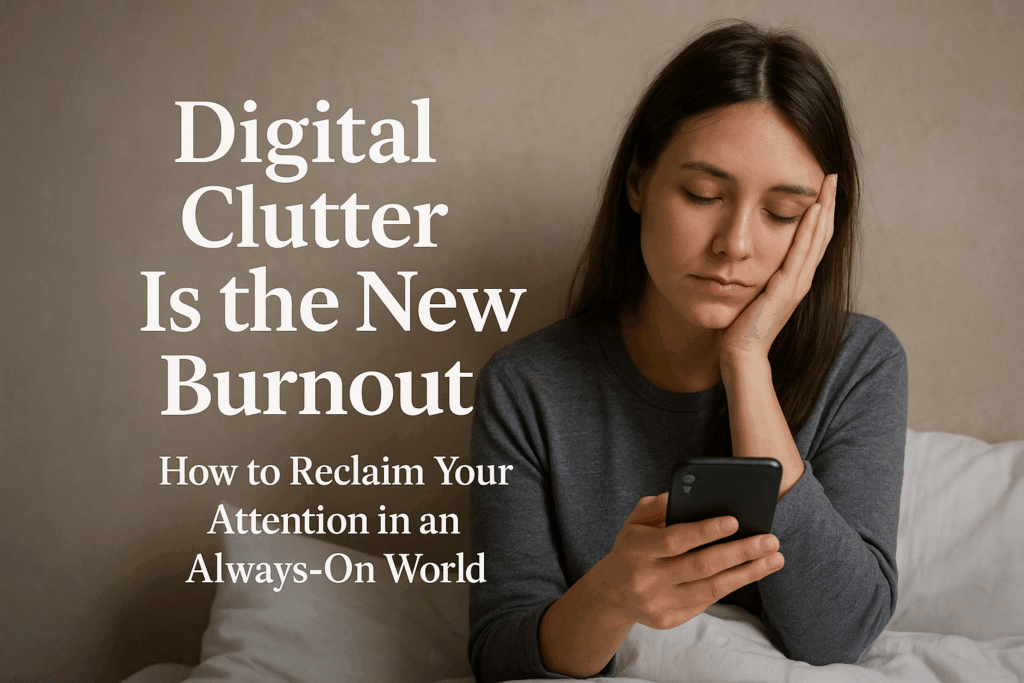
The Quiet Fatigue
There is a fatigue that hides beneath productivity. It doesn’t announce itself with yawns or heavy limbs, but with restlessness — a mind too crowded to think, too overstimulated to rest. This is the new face of burnout. Not the physical exhaustion of long hours or hard labour, but a quieter, digital depletion: the erosion of focus, the dull ache of constant connection.
We live in an age that rewards immediacy. Every message, alert, and notification demands a fragment of our attention, each one leaving a residue that scatters the mind. The science has caught up with what most of us already feel — that multitasking across digital platforms fractures our ability to concentrate. In a landmark Stanford study, participants who frequently switched between media streams performed worse on attention tests and had reduced working memory capacity (Ophir, Nass & Wagner, 2009). What we call “staying connected” might better be described as “staying fragmented.”
The Nervous System’s Toll
Our nervous systems are paying the price. Each vibration, ping, or flashing dot triggers a micro-stress response — a drip-feed of cortisol that keeps the body subtly on edge. The research is sobering: high mobile phone use is linked to disrupted sleep, anxiety, and depressive symptoms (Thomée et al., 2011). We are living in a near-permanent state of mild arousal, our bodies braced for the next interruption. Even rest no longer feels restorative; it feels interrupted.
Reclaiming Stillness
And yet, the solution isn’t to abandon technology altogether. The real task is to live consciously with it — to create a sense of digital hygiene that protects, rather than pollutes, our mental landscape. Evidence shows that simple boundaries can dramatically reduce stress. One experiment found that checking email less often led to lower daily stress and greater wellbeing (Kushlev & Dunn, 2015). The act of silencing notifications or carving out device-free moments isn’t a retreat from the modern world; it’s a reclamation of sovereignty over our attention.
Practices of focus and restoration have always existed — meditation, breathwork, intentional solitude — but they’ve taken on a new urgency in the digital age. Mindfulness, once dismissed as indulgent, is now recognised as a practical countermeasure to cognitive overload. Studies have shown that regular mindfulness practice improves attention regulation and reduces anxiety (Goyal et al., 2014). These rituals are less about “switching off” and more about tuning back in — to the body, the breath, the self that exists beyond the screen.
The Radical Choice
Reclaiming our attention is, at its core, a moral act. In an economy built on distraction, choosing to be present is an act of quiet rebellion. It’s saying that our inner lives matter more than the algorithms competing for them. The challenge of modern wellbeing isn’t just managing time; it’s defending depth — the capacity to think clearly, feel fully, and rest without guilt.
So the question is not how to do more, but how to do less with intention. To read one thing at a time. To leave some messages unanswered. To allow stillness to return as a natural state rather than a scheduled task. Because in a world that never stops asking for our attention, peace begins with the quiet, deliberate act of pausing.
Love Life x
References
- Ophir, E., Nass, C., & Wagner, A. D. (2009). Cognitive control in media multitaskers. Proceedings of the National Academy of Sciences, 106(37), 15583–15587.
- Thomée, S., Härenstam, A., & Hagberg, M. (2011). Mobile phone use and stress, sleep disturbances, and symptoms of depression among young adults – a prospective cohort study. BMC Public Health, 11(1), 66.
- Goyal, M., et al. (2014). Meditation programs for psychological stress and well-being: A systematic review and meta-analysis. JAMA Internal Medicine, 174(3), 357–368.
- Kushlev, K., & Dunn, E. W. (2015). Checking email less frequently reduces stress. Computers in Human Behavior, 43, 220–228.
- Przybylski, A. K., Murayama, K., DeHaan, C. R., & Gladwell, V. (2013). Motivational, emotional, and behavioral correlates of fear of missing out. Computers in Human Behavior, 29(4), 1841–1848.